
Connecting the Last Mile When It Matters Most
Exploring connectivity for always-on, secure communications in Himalayan disaster zones and the floodplains of Bangladesh Across some of the world’s most exposed landscapes, a communications failure can quickly become a humanitarian failure. We are working collaboratively, through a social-enterprise approach, to test whether resilient last-mile connectivity can help communities, responders and essential services remain connected before, during and after disaster. “Connectivity is not simply about internet access. In a disaster, it is the thread linking warnings, local leadership, health care, logistics, family contact and coordinated response.”
7/19/20264 min read
The geography of disconnection
The Himalayas and the floodplains of Bangladesh could scarcely look more different, yet they share a common vulnerability. In the mountains, communities may be separated by steep terrain, landslides, snow, damaged roads and long distances from major telecommunications infrastructure. In Bangladesh, densely populated low-lying areas can be isolated by monsoon flooding, river erosion, cyclones and the sudden loss of roads, power and mobile coverage.
When conventional networks fail, the consequences are immediate. Local authorities may struggle to issue warnings or confirm which settlements are affected. Health workers can lose contact with referral hospitals. Relief organisations may not know where supplies are most urgently needed. Families cannot confirm whether relatives are safe. Even where national networks remain operational, the final connection into an isolated village, clinic, shelter or field team may be the weakest point.
That is why the last mile matters. A network is only useful when it reaches the people who need it, under the conditions in which they actually live and work.
A collaborative social-enterprise approach
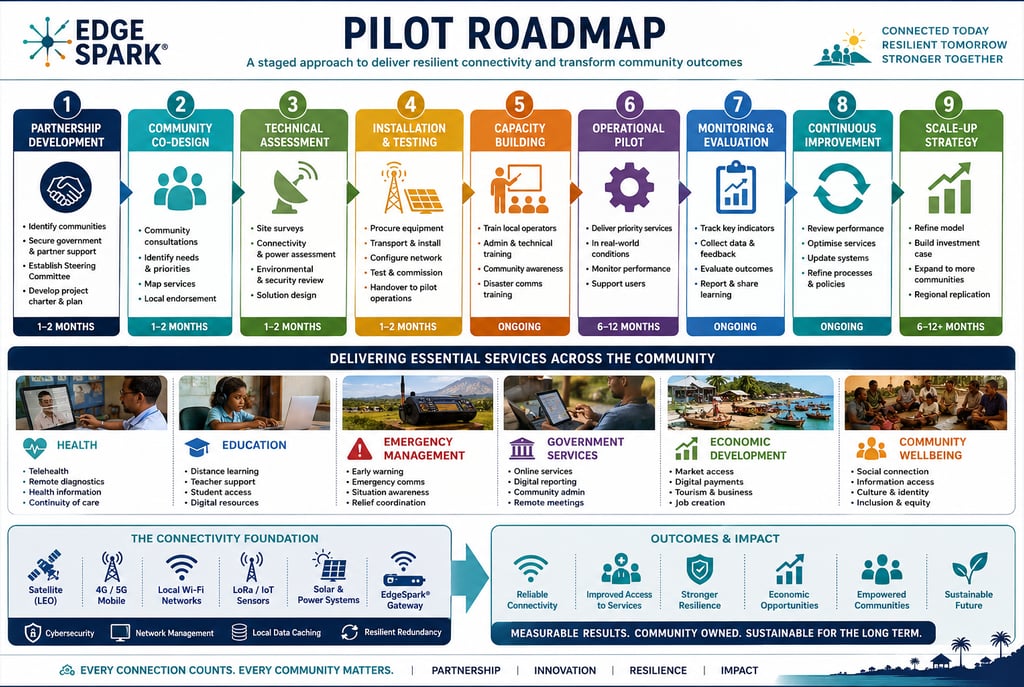
Our role is not to arrive with a predetermined technology and declare the problem solved. We are working with social enterprises, technical specialists, humanitarian and development partners, and prospective local delivery organisations to pursue the viability of an EdgeSpark Anywhere connectivity model in these environments.
The social-enterprise approach is important. It combines public purpose with commercial discipline. The aim is to develop a model that is affordable enough to be sustained, robust enough to be trusted, and flexible enough to be operated with local partners rather than remaining dependent on a distant project team. Any viable solution must consider not only equipment and installation, but also maintenance, training, subscriptions, energy supply, local ownership, security, repair pathways and the cost of keeping the service available year after year.
Collaboration also helps prevent a common mistake in disaster technology: designing around assumptions instead of lived conditions. Local organisations understand seasonal access, community decision-making, language, power availability, security risks and the practical realities of maintaining equipment in remote or flood-prone settings. Their knowledge is essential to deciding where connectivity is most valuable and how it should be deployed.
What the model is intended to provide
The concept being explored is straightforward: provide dependable last-mile connectivity that can remain available when ordinary communications are weak, congested or disrupted. Depending on site conditions, this may involve a portable or fixed connectivity node, access to more than one communications pathway, independent power options and a secure local connection for authorised users.
The objective is not merely faster internet. It is continuity. Always-on connectivity means designing for failover, so the loss of one carrier, link or power source does not automatically silence an entire location. Secure encrypted internet connections are equally important. Disaster settings involve sensitive information, including health details, the location of vulnerable people, operational plans and the movement of supplies. Resilience without security can create new risks; security without usability can leave systems unused. Both must be designed together.
A practical EdgeSpark Anywhere deployment could support a community coordination point, health post, evacuation centre, mobile response team or local government facility. From that point, authorised users could access emergency information, communicate with regional coordination centres, support telehealth, update logistics, use mapping and weather services, and maintain contact with families and partner organisations.
From technology trial to viable service
The current focus is viability. Before any larger rollout, the model needs to be tested against real operational questions. Can the equipment withstand heat, dust, moisture, altitude and repeated transport? Can it be powered through outages or prolonged isolation? How quickly can local staff establish a connection? What happens when a component fails? Can remote support be provided securely? What level of bandwidth is genuinely required for emergency communications, telehealth and coordination? Most importantly, who owns, manages and pays for the service after the pilot period?
We are therefore looking beyond a single demonstration. A credible pathway includes site-selection criteria, community and government approvals, technical due diligence, cybersecurity controls, maintenance arrangements, training for local operators, clear data-governance rules and an agreed sustainability model. Evidence should include not only whether the system connects on a good day, but whether it continues to perform when roads are cut, power is unstable and demand rises sharply.
This approach also recognises that the Himalayas and Bangladesh will require different configurations. A mountain clinic accessible only by foot may need a compact, rugged solution with low power consumption. A floodplain evacuation centre may need rapid deployment, wider local coverage and the ability to support a larger number of users. The core principles can be consistent while the delivery model remains locally adapted.
Connectivity as part of disaster readiness
Disaster connectivity is often discussed only after a network has failed. We believe it should be treated as part of preparedness. Systems should be installed, tested and used during normal periods, so local operators are familiar with them before an emergency. Routine use might include telehealth, training, community administration, education, weather monitoring or coordination between local services. This creates everyday value while keeping the equipment active and the skills current.
It also strengthens trust. Communities are more likely to rely on a system during a crisis when it is already known, locally supported and connected to familiar institutions. A resilient communications point should complement local warning systems, radio, mobile networks and established disaster protocols, not replace them. The strongest model is layered: multiple ways to receive warnings, multiple ways to communicate, and clear local responsibility for deciding how information is shared.
A small connection with far-reaching value
In remote and disaster-prone regions, the most consequential infrastructure is not always the largest. A modest, reliable connection at the right location can enable a clinician to obtain advice, a local leader to confirm an evacuation route, a response team to request supplies, or a family to learn that someone is safe.
Our collaboration is pursuing whether EdgeSpark Anywhere connectivity can provide that dependable bridge: last-mile access, continuity when primary networks fail, and secure communications for the people coordinating on the ground. The work is still about testing, listening and building the right partnerships. But the need is clear. In places where water, terrain and distance can isolate communities within hours, resilient connectivity should not be treated as an optional extra. It is part of the essential infrastructure of safety, dignity and recovery.


Connect
Privacy | Terms | Disclaimer |© 2026


Making good ideas work
Navigate
Home
How We Work
Profile
FNC Field Notes
Contact