
From Isolation to Inclusion: What Digital Equity Actually Means for Rural and Indigenous Communities
For decades, remote communities—in Australia, Asia, and the Pacific—have been spoken about in terms of “gaps”: service gaps, infrastructure gaps, health gaps, education gaps. But far too often, these conversations reduce real people to a list of deficits.
ANYWHERE INTERNET
11/19/20251 min read
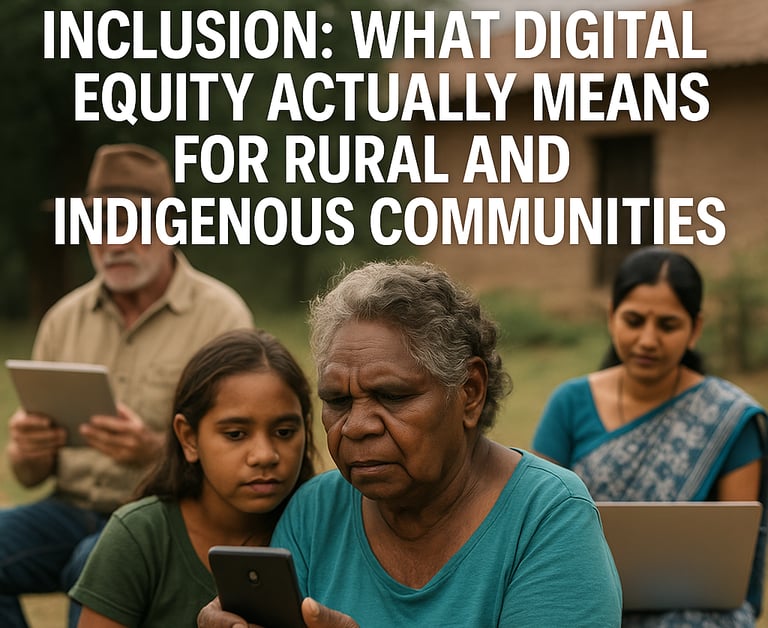
Digital equity reframes the conversation.
It recognises that connectivity is not about gaming, entertainment, or streaming. It is about voice, opportunity, fairness and health. For Indigenous communities, tribal villages and remote island populations, digital equity has become the baseline requirement for participation in the modern world.
Digital Equity Is Not Just Internet
Digital equity means:
Women’s safety tools that function offline and online
Youth learning opportunities beyond what a local school can offer
Telehealth and AI triage for communities without doctors
Employment pathways connected to new digital jobs
Cultural continuity, where elders and youth can use technology to document history, language and cultural knowledge
Economic participation through trade, microenterprise and digital payments
Community leadership, with local committees controlling how technology is used, secured and maintained
When connectivity reaches a community for the first time, it is not a technical event it is a social shift.
Lessons from Remote Australia
Over 30 years of work across Aboriginal communities, homelands and remote settlements, one truth has remained consistent:
People know the value of connection the moment they finally have it.
Mothers use WhatsApp to stay connected to children studying down south. Local health workers access immediate specialist advice. Rangers coordinate fire management with real time mapping tools. Youth can access safe spaces, learning resources and employment networks.
Digital equity empowers individuals, but it also strengthens the community fabric.
Lessons from South Asia and the Pacific
In Himalayan villages, connectivity means:
Weather alerts
Landslide updates
Drone coordination
Remote medical triage
Education continuity
In the Bangladesh delta, connectivity means:
Flood early warnings
Telehealth in isolation
Support to women’s cooperatives
Mobile banking
Coordination during cyclones
In Vanuatu, connectivity means:
Access to health triage tools like Helfie.ai
Digital classrooms
Government service access
Women’s safety tools
Disaster readiness
Digital Equity Changes Trajectories
When communities move from isolation to inclusion, the effects run across generations:
Children’s futures expand
Women have greater safety and autonomy
Traditional leaders access stronger governance tools
Local economies grow
National resilience improves
Digital equity is not a luxury.
It is the foundation for equal participation in the future.


Connect
Privacy | Terms | Disclaimer |© 2026


Making good ideas work
Navigate
Home
How We Work
Profile
FNC Field Notes
Contact