
When the Water Rises, Connectivity Must Hold
A regional flood showed how well coordinated warnings and communication can protect a community. A major telecommunications outage months later revealed how quickly that protection can disappear when there is no independent backup.
7/18/20266 min read
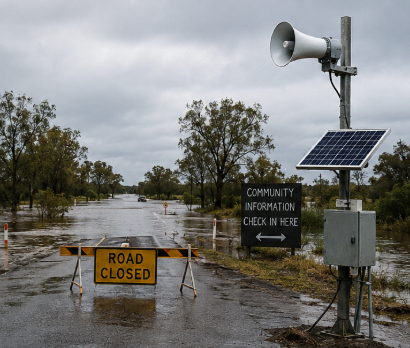
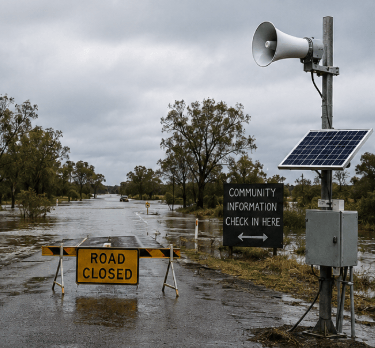
For several weeks, I lived and worked through an extended period of flooding in regional Australia. The place itself is not important. What matters is what the experience revealed: in a disaster, information is not an optional extra. It is part of the emergency infrastructure.
A flood that tested the whole system
Floodwater changes the shape of daily life. Roads disappear. Familiar routes become dangerous or unusable. Deliveries slow down. Staff cannot always reach their workplaces. Families are separated, vulnerable residents are moved, and decisions that would normally be routine become urgent.
During the flood, many of the established arrangements worked relatively well. Warning messages were issued. Local alerts helped signal changing conditions. Community leaders, emergency services and local organisations shared information. There were identifiable communication points where people could ask questions, report concerns and receive practical direction. In effect, there was a reasonably clear single point of entry into the emergency information system rather than a confusing collection of disconnected messages.
That mattered. In uncertain conditions, people need to know where to turn. They need one trusted source of truth, supported by several ways of receiving it. A siren may reach someone who does not have a phone. A text message may reach a worker away from the community. A radio call may reach a vehicle on the road. A local contact person may be the only effective channel for an older person, someone with disability, or a resident who does not readily understand a formal emergency notice.
When communication works, it can become almost invisible
One of the paradoxes of good emergency communication is that, when it functions, people can underestimate how much is holding it together. The warnings arrive. The phone rings. The message is passed on. The right person is contacted. The welfare check occurs. The vehicle is redirected. The family receives an update.
Because the system operated reasonably well during the flood, it was tempting to conclude that the communications arrangements were robust. In reality, much of the success still depended on ordinary commercial networks remaining available, devices being charged, local power continuing, and key people being able to access the same information at the same time.
The experience showed the value of local coordination, but it also raised a deeper question: what happens when the communications platform itself fails?
The outage that changed the lesson
Some months later, a major telecommunications carrier experienced a significant outage. Again, the company and the location do not need to be named. The important point is that the disruption was not caused by rising water, a damaged road or an evacuation. It was a failure within the communications network itself.
Phones stopped working. Calls could not be made or received. Messages were delayed or did not arrive. Services and individuals who had come to rely on one network suddenly had no reliable way to communicate.
The outage was a sharper reminder than the flood. During the flood, we were watching the weather, roads, river levels and physical access. We knew we were in an emergency and adjusted accordingly. During the carrier outage, the physical environment appeared normal, yet the ability to coordinate assistance was weakened almost instantly.
That contrast exposed a central vulnerability. A community can have sirens, emergency plans, call trees, contact lists and capable staff, but if nearly every pathway ultimately depends on the same carrier, tower, backhaul route or power source, the system is not truly resilient. It has a single point of failure hidden beneath multiple devices and services.
Backup connectivity is not duplication for its own sake
Resilience requires genuine independence. A backup service is useful only when it does not fail for the same reason as the primary service.
That may mean combining terrestrial mobile networks with satellite connectivity. It may mean ensuring key facilities can use more than one carrier. It may include satellite phones, independent internet terminals, radio systems, portable power, battery storage and pre-positioned communication kits. It also means designing the operating procedures that determine who activates the backup, who has access, how it is tested and how information is distributed when the normal channels are unavailable.
The objective is not to fill a storeroom with rarely used equipment. The objective is to maintain a minimum operational communications capability when the primary network is lost.
That minimum capability should support emergency calls, welfare checks, coordination with health and emergency services, staff mobilisation, public warnings, family contact and the secure exchange of essential information. It should be simple enough to use under pressure and familiar enough that staff do not need to learn it during the emergency.
Vulnerable people experience network failure first and hardest
The consequences of lost connectivity are not evenly distributed. A healthy adult with a vehicle, multiple devices and several social contacts may be inconvenienced. An older person living alone may be placed at immediate risk. A person receiving home care may miss a visit. Someone dependent on medication, oxygen, dialysis, wound care or mobility support may not be able to seek help. A family caring for a person with disability may lose contact with the very services that make it possible to remain safely at home.
Remote and regional communities also face longer distances, fewer alternative services and less redundancy in staffing and transport. When communications fail, there may be no nearby office to visit and no second provider with coverage. People may depend heavily on a small number of trusted workers who themselves rely on the same network.
For this reason, disaster-resilient connectivity should be designed around the people most at risk, not around the average user. If the system works for an older resident with limited mobility, a person with hearing or vision impairment, someone with low digital literacy, or a family living beyond reliable mobile coverage, it will generally work better for everyone.
A single point of entry still matters, but it needs multiple pathways
The flood demonstrated the importance of a clear communication hub: a place, number, service or team through which information can enter, be verified and then be distributed. That approach reduces rumours, duplication and conflicting instructions.
However, a single point of entry must not become a single technical point of failure. The coordination function can be centralised while the communications pathways remain diverse.
A resilient model might allow the same emergency coordination point to receive information through mobile phone, satellite internet, radio, email, messaging platforms and in-person reporting. It can then issue consistent updates through sirens, text alerts, local radio, social media, noticeboards, community vehicles and trusted local workers.
The principle is straightforward: one coordinated message, many independent ways to send and receive it.
From lessons observed to systems designed
The flood was not a story of complete communications failure. In many respects, it was a story of people and systems working well under sustained pressure. That is precisely why the later carrier outage was so instructive. It showed that success during one emergency does not prove resilience against another.
Real-time connectivity should be treated in the same way as water, power and road access: as essential infrastructure that requires contingency planning. Organisations responsible for vulnerable people should know which services depend on which networks, where the single points of failure sit, what backup options exist and how long those options can operate without mains power.
They should test those arrangements regularly. A backup phone that has not been charged, a satellite terminal that no one knows how to activate, or a contact list stored only in the cloud is not a backup in any practical sense.
Connectivity is care
The strongest lesson from both experiences is simple. Connectivity is not merely about convenience, faster internet or better administration. In an emergency, connectivity is care.
It is the warning that reaches a family before the road closes. It is the call that confirms an older person is safe. It is the message that directs a vehicle to the right place. It is the link between a remote worker and a clinician. It is the reassurance that help is on the way.
The flood demonstrated the value of coordinated, real-time communication. The later network outage revealed the danger of assuming that the communication layer will always be there.
Communities do not need technology for technology's sake. They need communication systems that continue to function when conditions are at their worst. That means multiple pathways, independent backup, local capability, secure information exchange and special attention to those who cannot simply make another call, drive to another town or wait for the network to return.
When the water rises, when the road closes or when the carrier goes silent, connectivity must hold.
One coordinated message. Multiple independent pathways. A tested backup that still works when the primary network does not.


Connect
Privacy | Terms | Disclaimer |© 2026


Making good ideas work
Navigate
Home
How We Work
Profile
FNC Field Notes
Contact